A sump pump backup plan should answer more than one question. It needs to cover a power outage, primary-pump failure, a stuck float, a blocked discharge, unusually fast inflow, an alarm, and the person who will respond. These eight checks help Rochester homeowners define that plan without assuming one backup product fits every house.
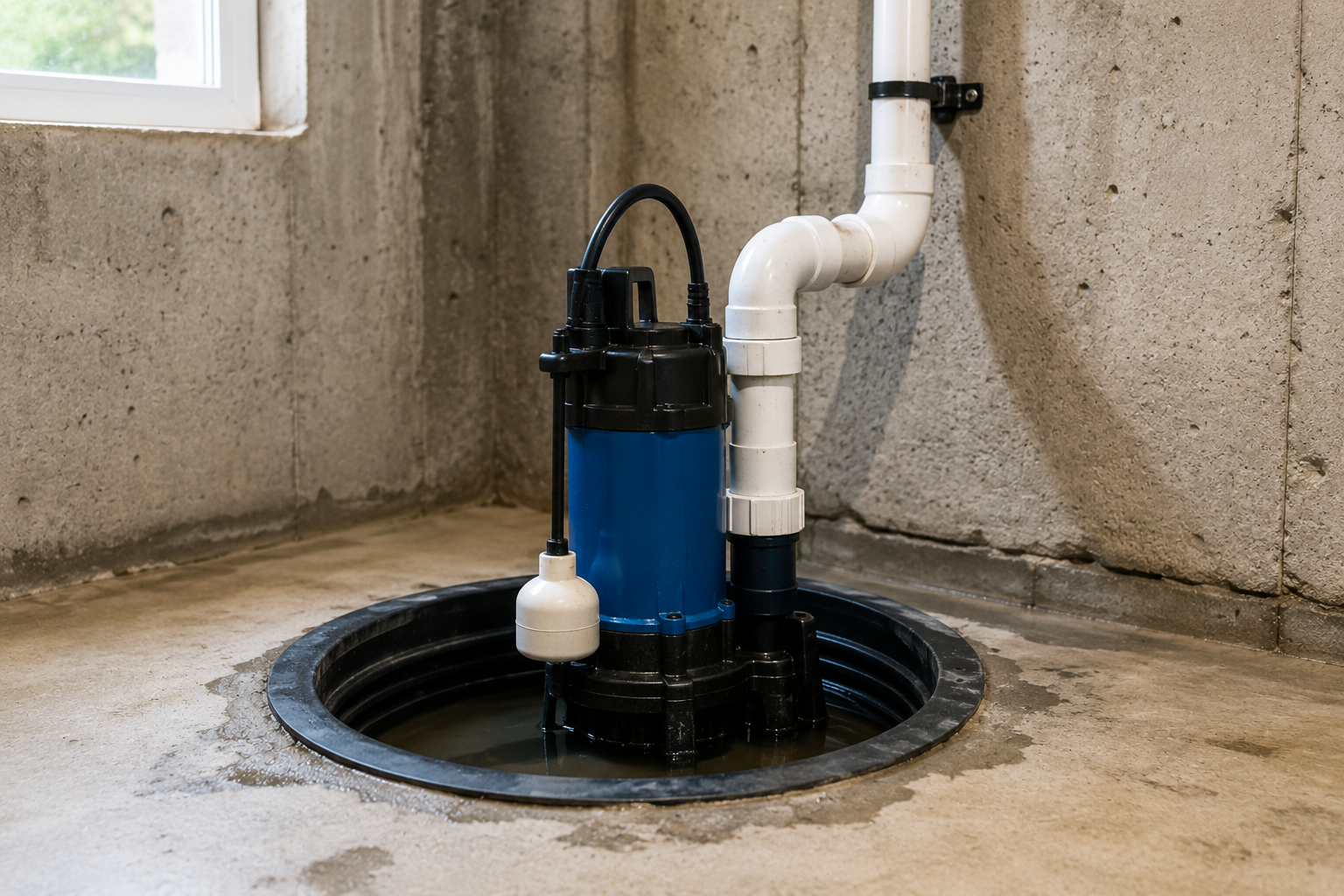
Sump Pump Backup Plan: Eight Essential Checks
1. List the failures the backup must cover
Write down the realistic failure modes at the property: utility outage, failed motor, jammed or obstructed float, failed check valve, frozen or blocked outlet, overwhelmed capacity, disconnected power, or a warning no one receives. Backup power alone does not help if the primary pump itself cannot move water.
2. Confirm that the backup has independent activation
Ask what activates the backup and at what water level. A separate pump and switch can address some mechanical failures that a power source serving only the primary pump cannot. The installation should leave the pit, cover, switches, and piping serviceable rather than crowding components together.
3. Match the power source to the pump and outage scenario
A battery system, permanently installed generator connection, portable generator plan, or water-powered backup has different requirements and limits. Have a qualified installer confirm electrical compatibility, starting load, operating time, ventilation, transfer equipment, fuel or water requirements, and installation code. Never run a fuel-burning generator indoors, in a garage, or near openings.
4. Define capacity in terms of actual cycling
Battery labels and pump ratings do not by themselves predict how long a system will protect one basement. Runtime changes with pumping rate, lift, pipe restrictions, battery condition, temperature, and how often the pump starts. Record the primary pump’s behavior during a demanding event, then ask how the proposed backup performs under a comparable load.
5. Trace the full discharge route
Follow accessible pipe to the visible outlet. Confirm whether the primary and backup share piping, where check valves are located, and what happens if the exterior endpoint freezes or is buried by snow. The outlet should send water to a lawful, functioning location without immediately returning it toward the foundation or a neighboring property.
6. Add a high-water alarm and a real notification path
A local alarm helps only if someone can hear it. A connected alert depends on its sensor, power, network or cellular path, application settings, and recipient. Test the full chain and decide who responds when the homeowner is away. Keep instructions and service contacts where another responsible person can find them.
7. Use the manufacturer’s inspection and test procedure
Record the model, installation date, battery or power-source type, service history, and specified test interval. Check status indicators and test only under dry, safe conditions using the manufacturer’s instructions. Do not reach into a pit, handle plugs, or service equipment while standing in water.
8. Write the response steps before an alarm occurs
The sump pump backup plan should state who receives the alert, where the shutoffs and panel are, when to call for service, and when to leave the area. Store valuables and porous materials above the floor. Keep dated photographs of the pit, controls, outlet, and normal water level for comparison.
Primary and Backup Scenarios to Compare
| Scenario | Question for the plan | Evidence to record |
|---|---|---|
| Utility power fails | What powers a pump, and for what expected duty cycle? | Outage duration, backup status, water rise, cycles |
| Primary pump fails | Is there an independent pump and switch? | Motor sound, float movement, water level, alarm |
| Discharge is blocked | Can either pump move water to a working outlet? | Visible ice, leaks, backflow, endpoint condition |
| Inflow exceeds capacity | What warning occurs before water reaches the floor? | Cycle frequency, highest water level, first wet point |
Why Backup Planning Matters During Storms
FEMA’s basement flooding mitigation material identifies primary-pump failure, power loss, and heavy-rain inflow as basement-flooding scenarios and prompts homeowners to consider battery backup. Ready.gov’s power-outage guidance also emphasizes planning for essential powered equipment and safe generator use.
This page focuses on system resilience. A sump pump backup plan connects the equipment, alarm, discharge route, and response steps. Use the existing Rochester sump-pump storm checklist for a short pre-event inspection and the sump pump installation guide for pit, pump, cover, capacity, and discharge questions.
When a Pump Problem Is Urgent
Leave the affected area and seek appropriate emergency or professional help when water may contact electrical equipment, sewage is present, water rises rapidly, a breaker repeatedly trips, or the structure shows sudden movement. Do not enter floodwater to reach the pump. A sump pump backup plan does not correct sewer backup, every wall leak, poor grading, or a moving foundation.
If water is reaching the pit because of a broader drainage or wall condition, review Rochester basement waterproofing options. For proposal comparisons, use the basement repair cost factors checklist.
Request a Rochester sump-pump contractor match.
Service disclosure: Rochester Basement Repair is an information and contractor-referral service, not a general contractor. It does not design, install, test, or maintain sump systems and does not guarantee protection or a contractor match. Verify product instructions, qualifications, permits, electrical/plumbing requirements, insurance, scope, and warranty terms.